5 Mistakes Many Owners Make During Walks
Published: 2026. 02. 23. 07:30 -
- Photos: welovedogz.hu • 5 minutes readingPublished: 2026. 02. 23. 07:30 -
- Photos: welovedogz.hu • 5 minutes reading
 Set WeloveDogz to appear first in Google search results!
Walking a dog is much more than physical tiring-out: it is one of the best tools for socialisation, training and the continuous shaping of the dog–owner relationship. Do you know the 5 mistakes that many owners unconsciously – and even with good intentions – may commit during walks?
As modern, responsible owners, we know that a walk is not only a health walk: it is a collection of physical and mental stimuli, as well as a wealth of opportunities for socialisation and learning for dogs, and for the two-legged ones stepping along at the other end of the leash it is one of the best tools for the continuous shaping of dog training and the dog–owner relationship.
It is becoming increasingly widespread to treat the dog as a partner, as an equal party during walks: let them decide, let them sniff, let them go where they would like. The problem begins when the walk becomes unstructured and the leash becomes merely a “formality”.
Many owners feel that by using a loose leash and letting go of control they are favouring their dog. However, the leash is not a restriction but a communication tool: it gives subtle feedback about when we move forward, when we slow down, and when cooperation is needed. If there is no real guidance on the leash, the dog is forced to make decisions continuously, as a result of which it may be harder for us to regain control, and for the dog in the long term it can even be mentally tiring.
For dogs, predictability means safety. If every walk is random, if the dog always decides everything, it can create a constant state of readiness. According to ethological research, consistent frameworks – including conscious leash use – reduce stress and help the dog navigate the stimulus-rich environment.
What can you do? Allow sniffing and independence, but have returning points: when we set off, when we move on. Use the leash as a signal. Rules – and properly interpreted leash use – do not take away freedom, but make the walk understandable and safe.
The basis of rewarding is positive reinforcement, but it matters when and for what the reward arrives. During walks it is common for the owner to give a treat when the dog is excited, tense or reacting excessively to a stimulus – just to calm them down. From a behavioural science perspective this is problematic behaviour: in such cases we are not rewarding the calm state or a task solved well, but the overexcitement.
What can you do? The treat should arrive only when your dog shows the behaviour you want to reinforce: they look at you, slow down, let go of a stimulus.
Many owners complete the daily kilometres at a pace like a timed training session, yet they experience that their dog is restless at home or bored. The reason is often that the walk is physically tiring for our four-legged favourite, but mentally it is not.
Research proves that sniffing, problem solving and decision making tire a dog more than walking at a steady pace. A walk taken along a monotonous route, on a tight leash, without stops is not mentally satisfying enough for a stimulus-hungry dog blessed with perfect senses.
What can you do? Change the route, include sniffing stops, let the dog gather information. A well-structured 30-minute walk can be worth more than an hour of automatic walking.
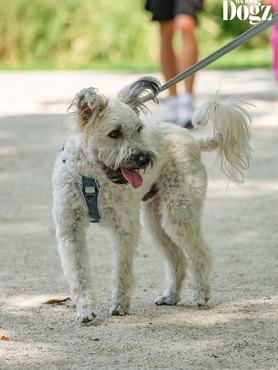
It is important that during the walk we observe our environment and our four-legged favourite so that we notice in time if they become tense. Many people only notice and consider problematic such spectacular reactions as barking, lunging or fleeing. Yet these are preceded by more subtle signals: frequent yawning, excessive sniffing, the body stiffening or unjustified scratching.
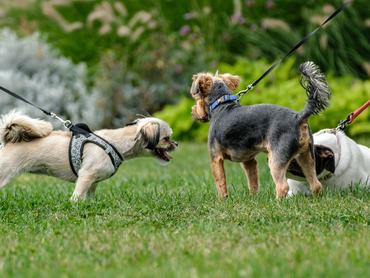
It is important that we know our dog’s body language and do not override their signals in our mind. If they become tense at the sight of an approaching dog, let us not walk over, even if the owner of the other four-legged one encourages it with the exclamation “they will just sniff each other”. Drawing boundaries is not impoliteness. If we do not do this, our dog will be forced to resort to stronger signals.
What can you do? Learn to read your dog’s body language, and dare to decide for them. Not every dog needs social interaction on every walk. A good walk is not good because your pet interacted with every single dog, but because throughout it they were able to handle the stimuli – and in this they could rely on you.
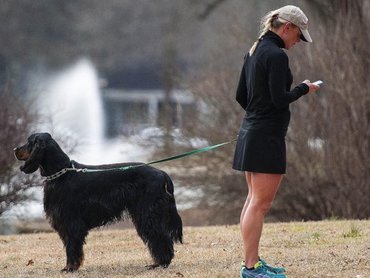
We do not dispute it: in today’s rushing world it is difficult to slow down. Walking the dog can often be boring for our brains overstimulated with information, so sometimes we look for extra stimuli: headphones, phone, and in our thoughts we are already somewhere completely different.
But for the dog the walk is primarily a shared experience, not a logistical task, not to mention that if you are not mentally present, you notice your dog’s signals more difficultly, or perhaps the threatening presence of a strange dog nearby. Our pets also sense stress in us, which can even spread to them.
What can you do? You do not have to train and entertain your four-legged one the whole time: for them it is enough that you are present. From time to time you speak to them, observe their reactions, and you are not just “accompanying” them, but you are going together.
We can see that many typical walking mistakes do not arise from bad intentions but quite the opposite: from attention, empathy, or from the desire to “do good” for our dog. The problem begins when these well-intentioned solutions operate without consistency, structure or understanding the dog’s real signals. A good walk is not good because everything happens perfectly, but because it is understandable, safe and processable for the dog. If we are able to pay attention to subtle stress signals, consciously use the leash, do not force automatic encounters, and give frameworks to independence, then the walk can truly become a recharging experience – for both parties.
As we've mentioned above, it is important to maintain balance - have structure in our day-to-day walks with our dog and also let them enjoy the activity. This is why it's important to let your dog sniff on walks.
Follow us!
facebook instagram youtube spotify
Related articles