Do Dogs Really Know Who's a Good Person and Who's Not? Tests Show Surprising Results
Published: 2025. 09. 21. 07:30 -
- Photos: welovedogz.hu/en • 5 minutes readingPublished: 2025. 09. 21. 07:30 -
- Photos: welovedogz.hu/en • 5 minutes reading
 Set WeloveDogz to appear first in Google search results!
Our best friends may not be as judgmental as we think.

Although we strongly believe that dogs can sense who is a good person and who is a bad person, new research shows that they may not actually judge people's character, at least not in the way we think.
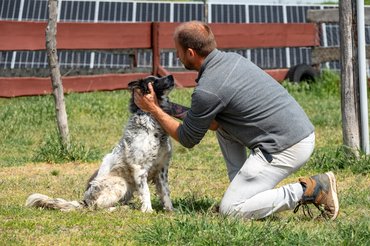
Recent tests conducted at Kyoto University have shown that dogs did not show a preference for a particular person even after seeing them display kindness or cruelty, revealing surprising limitations in their social evaluation abilities. When the dogs participating in the experiment observed how people treated other dogs, they did not later show a preference for the kinder person. Even direct interactions did not influence their behavior.
Many people trust dogs' instincts when it comes to humans. If dogs approach you on their own, dog lovers will probably consider you safe and trustworthy—but if dogs are wary of you, some may even question your character. However, how dogs evaluate people socially, if at all, remains a mystery.
Studies have shown that cognitively advanced and social species—such as chimpanzees—are capable of forming reputations, or judgments, about humans based on either direct interactions or observations of third-party interactions. The intimate relationship between dogs and humans, which has existed for thousands of years, has also aroused the curiosity of researchers, but the results of tests conducted on this topic have been inconsistent so far.
Previous research was conducted at the Wolf Science Center in Austria, where it was found that dogs and wolves living in packs do not form reputations about individual humans based on either direct or indirect experience. This non-judgmental attitude may be due to the fact that these animals have less experience interacting with humans, so more experienced dogs were needed for further studies.
In the new study, researchers observed the behavior of 40 domestic dogs to find out whether age and stage of development influence how they form impressions of humans. First, they created a situation where the dogs could "eavesdrop" on another dog interacting with two people: one was generous and fed the demonstration dog, while the other did not give it any food.
After observing the other dog's experiences, the dogs interacted directly with the two people while the researchers analyzed their behavior: for example, they recorded who they approached first, whether they jumped up on them, and how close they stayed to them. The results showed that dogs of all ages exhibited similar behavior: they did not prefer the generous person who fed the dog over the "selfish" person who refused to give them food. Their relationship with the two people did not differ from chance, either after indirect observation or direct experience.
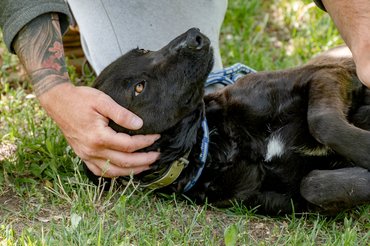
"It is clear that forming judgments may be more complicated than we previously thought—even for animals such as dogs, which work closely with humans," says Hoi-Lam Jim, the study's lead researcher. The study also highlights the methodological difficulties involved in accurately capturing dogs' ability to evaluate humans. Therefore, they emphasized that it is possible that the results reflect the methodological limitations of the experimental setup rather than the inability of dogs to evaluate humans.
According to the research team, in order to better understand what influences dogs' social cognitive abilities, future studies should regularly compare dogs of different ages, backgrounds, and living conditions—including stray dogs, service dogs, and police dogs. It seems obvious to many of us that dogs evaluate humans from a social perspective, but we cannot say this with certainty at this point.
On this topic, we immediately thought of a 2016 study that examined how dogs, when encountering a stranger, show social reference based solely on the direction of their owner's movements. Although this may seem very abstract, we will explain what we mean in a moment.
In fact, the above convoluted sentence simply means that dogs' behavior is largely determined by how their owners react to other people. According to a report in Psychology Today, a woman's dog, for example, showed fear when seeing men of color after its owner had previously been robbed by a young black man. Although the woman herself did not become prejudiced, the dog sensed her subtle body language and uncertainty and adjusted its own reactions accordingly.
Researcher Charlotte Duranton and her team conducted an experiment with 72 dogs to better understand this phenomenon. The owners were asked to either step toward, remain still, or step back when a stranger approached. The dogs' behavior changed noticeably depending on how their owner behaved. If the owner backed away, the dogs became more uncertain, spent more time observing, and moved closer to their owner. This phenomenon shows that dogs shape their own responses based on their owners' reactions. Even very small signals that seem insignificant to us are quickly incorporated into the dog's behavior. They simply mirror the way the owner reacts to their environment, even if subconsciously.
Is it possible that we live in such symbiosis with our dogs that they respond more to our reactions than to what they see with their own eyes? This is a particularly interesting idea because, according to the current view, dogs have no moral standards, so they do not judge what is right or wrong. Although it can be demonstrated that dogs react to unfair treatment in certain situations, many researchers believe that this is not due to their value system, but rather to social mechanisms that serve evolutionary advantages: dogs protect their own interests and safety, rather than making decisions based on abstract moral principles. (In this case, unfair treatment does not mean abuse. The consequences and effects of abuse differ from those currently under discussion.)
Follow us!
facebook instagram youtube spotify
Related articles