The 6 Tallest Dog Breeds in the World
Published: 2025. 12. 14. 07:30 -
- Photos: Getty Images Hungary; welovedogz.hu/en • 6 minutes readingPublished: 2025. 12. 14. 07:30 -
- Photos: Getty Images Hungary; welovedogz.hu/en • 6 minutes reading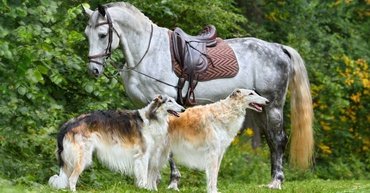
 Set WeloveDogz to appear first in Google search results!
When we think of large dogs, most of us rank them based on their weight. Of course, some breeds are impressive in terms of both height and weight, but the most massive four-legged animals are not necessarily the tallest.

In our article, we have compiled a list of the tallest dog breeds.
Breeds such as the Saint Bernard Dog, Russian Black Terrier, Scottish Deerhound, Afghan Hound, Caucasian Shepherd Dog, Kangal, and Leonberger were only slightly behind.
Height:
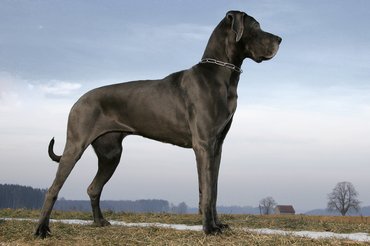
This is a dog breed with a particularly ancient history, whose ancestors are believed to have existed as early as 2500-3000 BC. Depictions from Roman, Chinese, and Egyptian times show dogs of this type accompanying humans on hunts, where they were used to kill wild boars, bears, and deer. Their ancestors also took part in wars in ancient Rome, and the Germans sent many dogs to the front during World War II.
Height:
During the Romanov dynasty, wolf hunting was a passion of the Russian aristocracy. The nobles organized ceremonial hunts—more like festivals, really—on their vast estates, transporting their guests, horses, and greyhounds in special hunting trains. It was not unusual for a hundred borzois and as many servants to take part in these lavish events. However, the revolution brought with it the mass extermination of the Romanov family, the nobility, and the aristocratic hunting dogs. As a result, the breeding of Russian greyhounds and other national breeds declined in the 20th century. If it hadn't been for foreign enthusiasts of the breed, there is a good chance that the Borzoi would have become extinct.
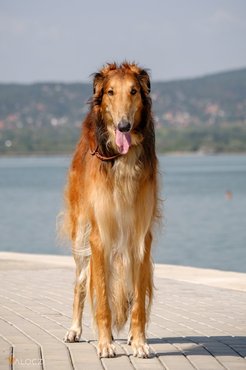
Height:
The long history of the Irish Wolfhound dates back to ancient times. It can be confidently stated that the large dogs native to Great Britain were crossed with agile, fast-moving, hound-like dogs from the Middle East, which were important commodities in trade. By the time the Roman Empire reached the British Isles, these giant dogs had long been native to the area. In 391, the Roman consul received seven such dogs as a gift, which "all of Rome marveled at." These majestic hunters were used to hunt prey such as the now extinct Irish elk (giant deer), which is said to have stood 180 cm tall. Later, they specialized in hunting wolves, and when these became extinct in the country in the 1700s, the breed almost disappeared. In 1862, British Army captain George Augustus Graham began searching the country for the remaining specimens of the breed, making the protection, standardization, and promotion of the wolfhound his life's work.
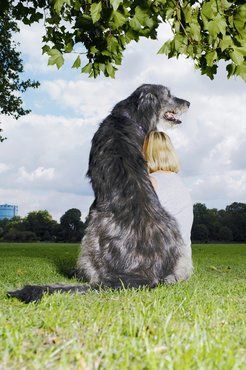
Height:
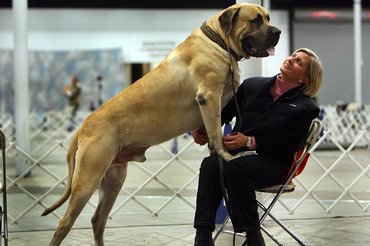
The Spanish Mastiff appeared on the Iberian Peninsula before the Roman conquest; more than 2,000 years before them, the Greeks and Phoenicians brought them with them. The first references to the region's mastiff can be found in the writings of Virgil, which date back to around 30 AD. In his poem Georgica, he mentions that the Iberian mastiff's caring nature makes it the best guardian and protector of flocks.
The role of mastiffs reached its peak in the 10th century, when organized and controlled animal breeding began in Europe; Spain was clearly outstanding in sheep breeding, and the country's economy was based on wool production and processing. This development reached its peak in the 12th century, when the breeding of a new breed of sheep began. These animals usually spent the winter in southern Spain and then migrated to the northern mountain slopes at the beginning of summer. The migrating flocks were accompanied by about 40,000 shepherds, with at least one mastiff for every 100 sheep, who protected not only the shepherds but also the flock. What a sight it must have been!
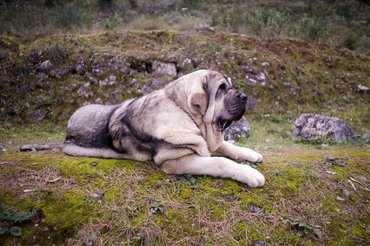
Height:
Although the origins of the Pyrenean Mastiff are not entirely known, it is generally accepted that it descends from the Molossers brought to Spain by the Phoenicians around 3,000 years ago. Due to the isolation of the Pyrenees mountains and various areas of present-day Spain, the original Molossers developed differently in each region, creating several sheepdog breeds, such as the Pyrenean Mastiff, the Spanish Mastiff, and the Pyrenean Mountain Dog.
In the 1930s and 40s, the disappearance of wolves and bears from the Pyrenees, the switch to rail transport for sheep, the Spanish Civil War, then World War II and food shortages led to the near extinction of mastiffs in Aragon. As these noble dogs could not find work due to their large size and high maintenance costs, they almost disappeared completely. However, in the 1970s, when wolves returned to the Aragon region, there was once again a need for these dogs, which we now know as Pyrenean Mastiffs.
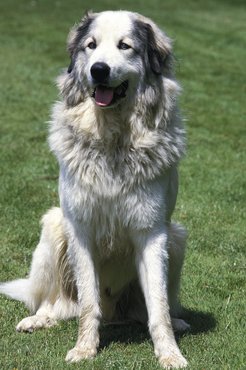
Height:
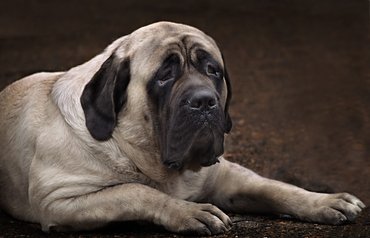
Mastiff-type dogs have been known around the world for thousands of years. Evidence from ancient Egypt, Greece, Rome, China, and Tibet all preserve traces of the fearsome giant dogs we refer to as mastiffs. The British mastiff type, or English mastiff, is also an ancient breed. When Julius Caesar invaded Britain in 55 BC, he was impressed by the dogs that faced his legions with death-defying courage. He recorded all this in his diary of his campaigns. These dogs captivated him so much that British mastiffs were taken to Rome to fight wild animals and human gladiators in the arena.
The English Mastiff as we know it today developed its characteristics in medieval England, where it had to prove itself in hunting large game, guarding estates at night, and serving as a war dog. In his work The Canterbury Tales, Chaucer refers to them as Alaunts (a French breed name) and describes them as "as big as an ox." And indeed, they are not only tall, but also incredibly heavy. With a weight of up to 104 kg, they are considered the largest dog breed in the world. (This is the upper limit for males according to the standard.)
The Turkish Mastiff, or Aksaray Malakli, was left off the list because neither the FCI nor the AKC officially recognizes it at this time. (This does not mean that there is anything wrong with the breed, but for the sake of simplicity, it was easier to rely on the data from these two organizations.) According to the Turkish Dog Federation standard, the height of the Malakli can be up to 97 cm for males.
Follow us!
facebook instagram youtube spotify
Related articles