The 5 Largest Canids in the World
Published: 2026. 05. 11. 07:30 -
- Photos: Getty Images Hungary • 6 minutes readingPublished: 2026. 05. 11. 07:30 -
- Photos: Getty Images Hungary • 6 minutes reading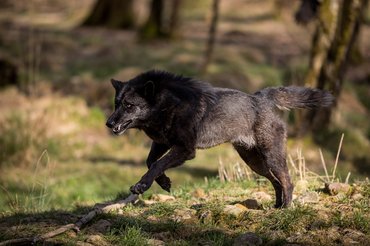
 Set WeloveDogz to appear first in Google search results!
When compiling the list, we took into account the animals’ maximum and minimum estimated body weights, but even so, we did not have an easy task. On the one hand, many species of remarkably similar size are included among the canids, while on the other hand, there are often quite significant differences between various sources regarding their sizes. Nevertheless, we tried to be as accurate as possible.

We shall not delay any longer, here come the world’s largest canids!
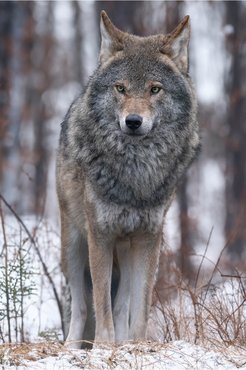
Body weight: approximately 14–65 kg; average body weight: 36–38 kg
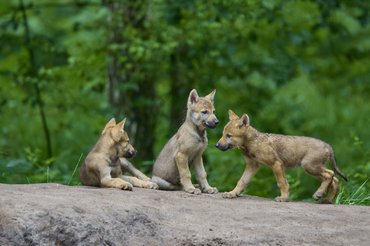
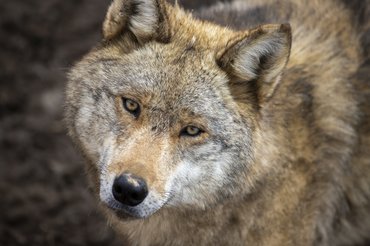
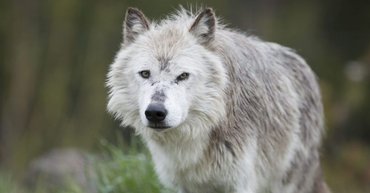
The grey wolf is the largest representative of the canines, whose ears are almost completely rounded compared to species of the Canis genus, while their muzzle is less elongated. Their incredibly nuanced cooperative hunting talent, as well as their social behaviour and communication, are among the most advanced in the animal kingdom. Pack members are closely bonded to one another, and it may even happen that they sacrifice themselves for each other. It has also been observed that when one member is lost, the cortisol levels of every individual in the pack rise due to the high level of stress.
Wolves communicate through sounds, body language, scent, touch, and taste. The characteristic wolf howl, which old beliefs associated with the position of the moon, actually serves to gather the pack before and after hunting or to sound an alarm. This is especially effective when crossing unfamiliar territory during storms. Research has also proven that wolves howl more with packmates to whom they are closer. Under certain circumstances, the howl can be heard across an area of up to 130 km². However, they do not bark in the same sense as dogs; rather, we may hear the occasional yelp from them – but they also whine, howl, and growl.
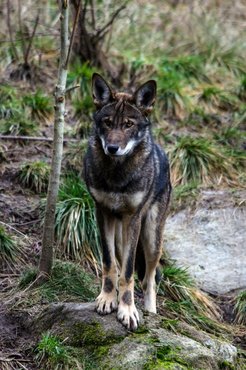
Body weight: approximately 20–40 kg
The red wolf, in other words America’s wolf, is a canine native to the south-eastern United States, who holds a critically endangered status according to the Red List. However, due to the debate surrounding them – or more precisely their taxonomic status – they are sometimes excluded from the list of endangered species, further reducing their chances of survival. Some believe they are part of a distinct lineage and therefore an independent species. Others consider them a recent hybrid of the grey wolf and the coyote, while another theory suggests they are an ancient hybrid of the same two species, which would also guarantee species status for them.
Researchers often compare them to greyhounds because they have particularly long and slender legs in the world of wolves. However, the “red” designation may be misleading: their base colour is greyish with pale markings, while the reddish-yellow shade can only be observed in certain areas, almost like shading. Naturally, they are also monogamous and live in packs; however, observations suggest they are more sociable than coyotes, but less social than grey wolves.
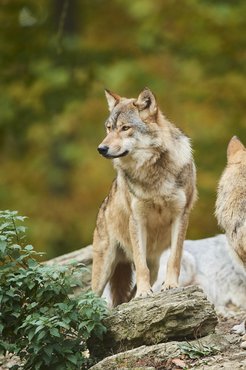
Body weight: approximately 20–35 kg
For years, it was believed that the eastern wolf was a subspecies of the grey wolf. However, recent genetic studies have proven that Ontario is home to two separate wolf species: the grey wolf and the eastern wolf. Interestingly, the latter is more closely related to the endangered red wolf than to their Canadian relative. The eastern wolf’s coat is generally an ashen greyish-brown colour mixed with cinnamon shades. Their sides and chest are reddish or cream-coloured, while the areas around the neck, shoulders, and tail are a mixture of black and grey. Unlike grey wolves, melanistic (black) individuals are rare among them.
Members of the species primarily hunt small and medium-sized prey, unlike the grey wolf, which is capable of efficiently taking down large ungulates. Although they are predators, packs living in Voyageurs National Park also gather blueberries during much of July and August when they are in season. Packs carefully avoid one another, and only solitary wolves venture into the territories of other packs. Their average territory is 118–185 km², while the earliest dispersal age for young eastern wolves is only 15 weeks – much earlier than in the case of grey wolves.
Body weight: approximately 20–30 kg
Although the maned wolf is a wolf in name, and strongly resembles a fox in appearance, they are neither wolf nor fox; they are the only living representative of the Chrysocyon genus, which belongs to the canine family. Once we have seen South America’s largest canine, we certainly never forget them; their long, slender legs make them the model of the canine world. And although they are a canine, studies suggest they cannot be linked to any living canine species. The conclusion is that the maned wolf is the only South American species to have survived the extinction process that occurred during the Late Pleistocene.
They earned the title of the tallest canine. This is mainly thanks to their long legs, which likely developed as an adaptation to the tall grasslands of their native habitat. On the reddish body, an imposing black mane can be observed around the neck area. It is thought to serve to increase the animal’s profile, since they can raise the hairs when feeling threatened or wishing to express aggression. They received the nickname “skunk-wolf” because the urine they use for marking territory has a strong cannabis- or hop-like smell. The substance responsible for the odour is most likely a compound called pyrazine, which occurs in both plants.
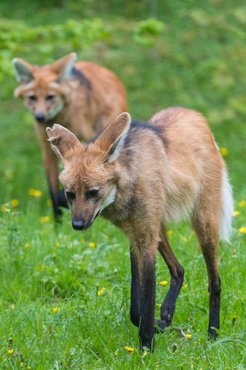
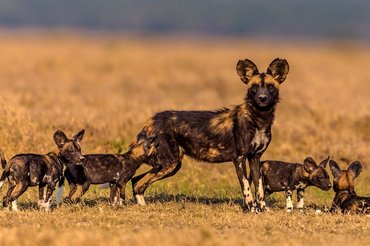
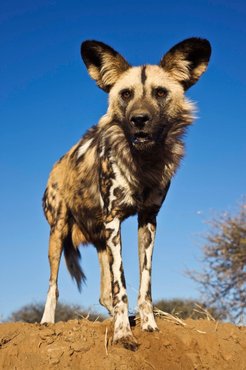
Body weight: approximately 18–36 kg; average body weight: approximately 20–25 kg
The African wild dog is the continent’s largest canine and the only living representative of the Lycaon genus. What distinguishes them most from representatives of the Canis genus (which includes, for example, the grey wolf, the golden jackal, and the dog) is that their dentition is specialised for a hypercarnivorous diet, and they lack dewclaws. The species possesses the most unique adaptive abilities among canines both in terms of coat colour and diet, as well as in the running abilities they employ while chasing prey. Their skeleton gives them a graceful appearance, while the missing dewclaw on the foreleg increases both the length of their stride and their speed. This adaptation enables them to pursue prey over long distances in open terrain.
They are even more social than lions. They are so attached to one another that if one individual becomes separated from the pack, they become depressed and may even die from broken-heart syndrome. Medicine records the condition under the name takotsubo cardiomyopathy, which refers to a type of heart muscle disorder. In response to elevated stress, hormones are produced that create symptoms similar to those of a heart attack. Due to the illness, part of the heart muscle enlarges.
(The opening image shows a melanistic, in other words black-coloured, grey wolf.)
Follow us!
facebook instagram youtube spotify
Related articles