Boston Terrier: the cheerful small dog with whom you will not be bored for a minute
Published: 2025. 07. 21. 07:30 -
- Photos: Getty Images Hungary • 5 minutes readingPublished: 2025. 07. 21. 07:30 -
- Photos: Getty Images Hungary • 5 minutes reading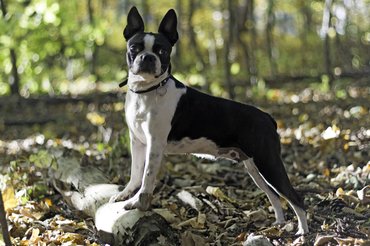
 Set WeloveDogz to appear first in Google search results!
Next to the energetic, lively Boston Terrier, their owner certainly cannot be bored. Their affectionate character makes them an excellent companion for almost anyone.

One of the Americans’ most beloved breeds, the Boston Terrier is often mentioned as the American gentleman because of their unique pattern. This cheerful, human-centred dog can be ideal for almost anyone, since their character is very affectionate and friendly. If their owner can provide them with lots of movement, play, they will find a perfect companion in their person.
From their name it is easy to realise that this dog breed originates from the United States of America, more precisely from Boston. They were bred approximately 150 years ago, presumably from English imported dogs. For many it may be surprising, but the original aim of their development was participation in dog fights. Their ancestors are the English Bulldog and the Bull Terrier (or their ancestor, the white terrier), but many believe that the French Bulldog may also be among their forebears. This is also indicated by the similarity – the Boston terrier could hardly deny their ancestors.
One of the breed’s first representatives was Judge, who came from Liverpool to Boston, and was born from a cross between a white terrier and a bulldog. The result was a taller, more agile dog than the latter, who according to records very much resembled today’s Boston Terriers. The new breed, however, did not really prove effective in dog fights, and not long after their development, this form of “entertainment” was banned. Thus, the Boston Terrier soon became a family pet kept for pleasure. So much so that at the beginning of the 20th century they were considered the first or second most popular dog breed in the United States, and they are still in a prestigious place on the list today.
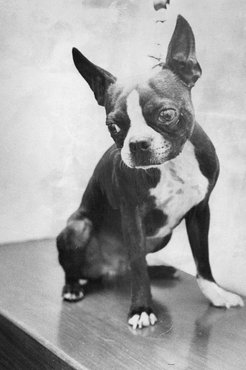
The fighting character over time developed into a friendly, kind personality, as during breeding those individuals possessing these traits were favoured. The breed was officially registered in 1893. And in 1979 the Boston Terrier was chosen as the official dog of the state of Massachusetts, and has been the mascot of Boston University for 99 years.
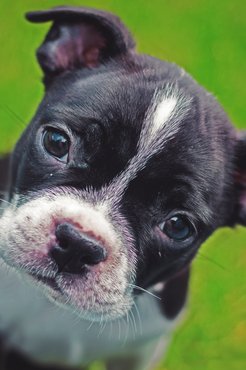
The Boston Terrier is a small-sized, compactly built companion dog. Their skull is flat, square, according to the standard wrinkle-free. Their gaze is intelligent, friendly, their eyes characteristically wide apart, large and rounded. Their colour is dark; blue is not allowed. Their small, upright ears are often cropped in those countries where this is still permitted. Their jaw is short, with some underbite. Their neck is medium-length, slightly arched. Their torso can be drawn into a square, their back is straight, slightly sloping toward the tail. Their limbs are well-muscled, strong, their paws small and rounded. Their tail is set low, short, straight or twisted in shape. Their coat is fine, silky to the touch, short. Their colour is black or brindle, with white markings. The white markings appear on the head, neck, chest, and forelimbs. On the hind legs, white markings below the hock joint are desirable.
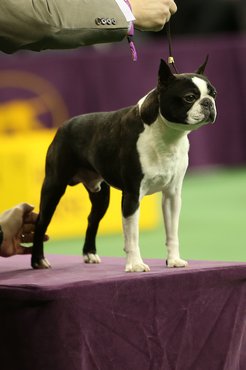
Although they exist in only one size, Boston Terriers are sometimes categorised into different groups. They distinguish those under 6.8 kg, 6.8–9 kg, and 9–11.3 kg dogs. The Boston terrier’s height at the withers may be proportionally about 35–43 cm. Their expected lifespan is 13–15 years.
The Boston Terrier is a real joker, whose cheerful nature brightens their family’s everyday life. They are endlessly affectionate, explicitly human-centred dog, who besides their wonderful qualities are also very intelligent. They are easy to train, gladly learn a few tricks and are an ideal partner for some dog sports too. They need a lot of movement, love to play, are almost full of energy. Many believe the Boston Terrier’s personality is much more like that of a bulldog than a terrier.

Fundamentally, their personality is peaceful, cheerful and balanced. Despite their energy, they do not tend to get overly excited, much more a playful companion, for whom the most important thing is to be near their loving family. They are explicitly friendly towards children too, adapt well to almost any life situation. However, they tolerate being alone badly, thanks to their affectionate nature. If a stranger approaches their home, they indicate it with loud barking. They are brave and spirited, however, apart from barking, they do nothing to the uninvited guest.
Because of their excellent adaptability, they feel equally good in a house with a garden and in a flat. Due to their energy, they need regular physical activity, walks, and of course, play. However, it is important that they do not overexert themself, since because of their short nose, breathing may at times be difficult. They are also kind and friendly towards children, but are also a great companion for elderly people. It is characteristic of them that they much prefer people to their own kind, but a properly raised, socialised Boston Terrier is not aggressive towards other dogs.
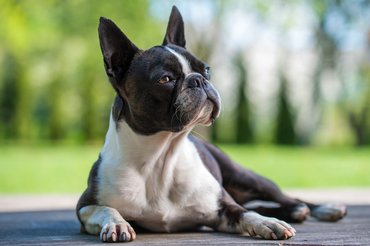
Their coat is easy to maintain, it only needs to be brushed occasionally. It is important that their slightly protruding eyes be cleaned often by their owner. Their ears also need to be cleaned regularly, and at these times attention should be paid to any lurking grass awns. Their claws need to be trimmed if they grow too long.
During the birth of Boston Terrier caesarean section often has to be used, as the puppies’ heads are often too large to pass through the birth canal. Responsible breeders already strive to breed dogs with relatively longer noses to avoid breathing problems. If the dog’s nose is too short, they have difficulty breathing, tolerate physical exertion and heat poorly. Boston terriers may develop heart disease and skin tumours. Due to their protruding eyes, they are sensitive to health problems affecting the visual organ, and cherry eye may also develop in them.
(Sources used: János Szinák – István Veress: The Dogs of the World I, János Szinák – István Veress: Dog Guide, Dr Pál Sárkány: International Dog Encyclopaedia, David Alderton: Dogs, Paul McGreevy: Dogs, Sarah Whitehead – Beverly Cuddy: Dogs)
Follow us!
facebook instagram youtube spotify
Related articles