Irish Setter: The Red Beauty Who, Walking in Nature, Turns Into A Genuine Hunter
Published: 2025. 08. 18. 07:30 -
- Photos: Getty Images Hungary • 6 minutes readingPublished: 2025. 08. 18. 07:30 -
- Photos: Getty Images Hungary • 6 minutes reading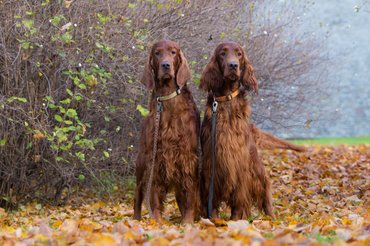
 Set WeloveDogz to appear first in Google search results!
The Irish Setter is a truly elegant, noble-looking dog. Their speciality is given by their dazzling coat, affectionate, kind personality and hunting instinct. Although nowadays they are kept more as a pet than as a hunting dog, still many swear by their talent.
Over the centuries, with their wavy, red coat, the Irish Setter more and more nestled themself into the homes of families, and together with this, into their hearts. Not accidentally, since through their affectionate, kind and gentle nature they get along well with children, being an excellent playmate. It is important to mention that despite their impressive, elegant appearance, they need a lot of exercise, one must not look at them as a show dog who is only there to look good. They require much activity and care, which they then repay with their kindness.
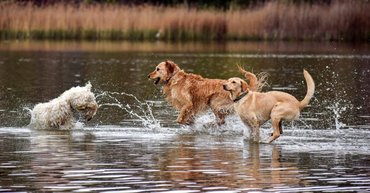
From their name we can easily deduce that the breed originates from Ireland. At the end of the 1700s they were bred mainly for hunting partridge and grouse. The word “setter” comes from the hunting term “set”, which means that the dog has to indicate to the hunter the location of the game. For this, of course, they first had to find the prey, for which the Irish Setter called upon their excellent sense of smell. At times they were used not only to indicate the location of the game, but also to retrieve it, for which reason they are a very good swimmer as well. Indeed, they even threw themself into icy water after the prey if the situation required it. Compared to the other setters, the Irish Setter is somewhat lighter, faster, thus they move better on the marshy Irish ground where originally, they had to hunt.
In their development, presumably the Irish Water Spaniel, various Pointers and other Setters may also have played a role. These dogs initially existed in red-and-white colour, from which later developed the today known Irish Setter, as well as the very rare Irish Red and White Setter. In the 1800s Hungarian hunters also took a liking to the setters and there were several enthusiastic admirers of such dogs.
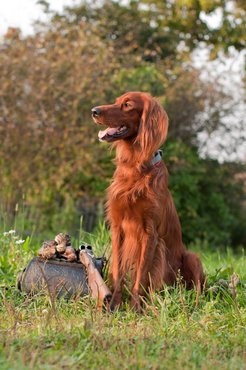
In an 18th issue of a “Zoologiai Lapok” from 1899 they already proudly wrote about the successful Paddy, the Irish Setter:
“The bitch is the descendant of the most famous, with countless 1st prizes decorated ancestors, and she herself also at the Frankfurt, Nuremberg, as well as the Erfurt exhibitions has been awarded with the highest distinctions. At the 1896 Heilbronn pointer competition she was also a prize-winner. The bitch, as the picture prepared at the Nuremberg exhibition by the order of the judging committee shows well enough, is a classically beautiful animal, and is at present raising a litter of 5 puppies from ‘Minco’, the at present most famous Irish Setter male dog belonging to Rezső Gatter, private individual in Vienna, which at pointer competitions has been decorated with first prizes 4 times. It is our pleasure that, through the kindness of our esteemed colleague, we could present this beautiful animal to our readers.”
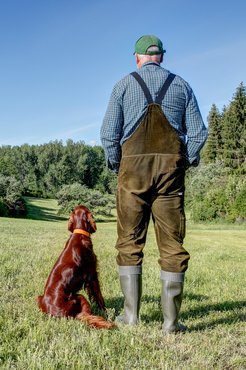
While for a long time the same individuals held their own both at exhibitions and at hunts, in the 19th century the different working lines of Irish Setters began to separate more and more from one another. During the First World War, although hunting dogs enjoyed exemption from military service, since a significant part of the country’s hunting grounds was annexed, there was no longer a need for so many hunting dogs. Thus the stock diminished greatly, and inbreeding became an increasingly serious problem. Breeders for profit also appeared, which further worsened the stock. The situation normalised a few years later when Irish Setters began to be imported into the country again. Since then, the breed has become a very popular family dog worldwide, however at hunts they are now more rarely encountered.
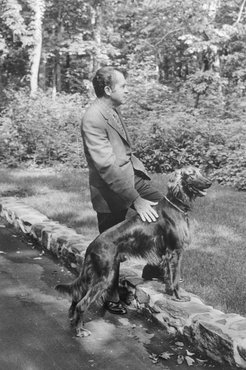
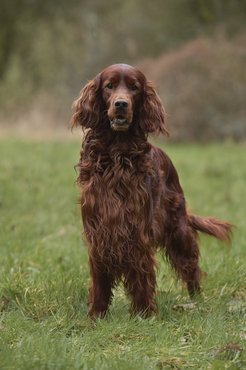
The Irish Setter is a truly noble-looking, mild-expressioned, medium-sized hunting dog. Their body structure is athletic, proportionate. Their head is elongated, their nose colour can be black, mahogany or dark walnut coloured. Their eyes are dark or hazel brown, almond-shaped. Their ears are of medium size, set low, lying close to the head. Their tail is of medium length, strong at the base, tapering towards the end. Their coat on the head, tip of the ears and the front of the limbs is short, fine to the touch. On the rest of the body it is moderately long, silky. Their colour is bright chestnut without black trace. Small white patches on the chest, and on the forehead or paws are permitted. Their withers height depending on sex is 58–69 cm, their body weight 23–32 kg. Their expected lifespan is 12–15 years.
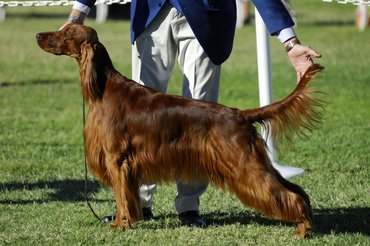
Breeders hold that although the statement is true for every dog, for the Irish Setter especially: every dog is a separate personality. While some individuals are obedient, compliant, others are prone to become somewhat unruly. What, however, in general can be said about all of them is that they are cheerful, kind and energetic dogs, who between four walls do not make much fuss, but if they are let out into nature, there is no stopping them. Due to their strong hunting instinct it is not recommended to walk them without a lead, since they can easily set off in pursuit of game. They are very closely attached to their family, affectionate and they require also the time spent with them. The Irish Setter is talented also in dog sports, for example in agility.
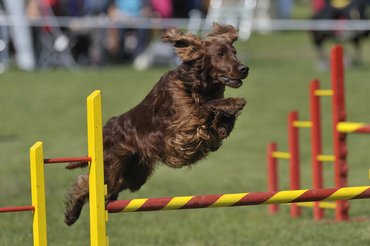
The red setter feels most at home in a house with a garden. But alongside a spacious yard with appropriate fencing, they also need several kilometres of walking, exercise daily. Not only their body, but their mind must also be tired out, since they require the time spent with them. They are an ideal playmate for children, kind and patient with them, in addition aggression is not at all characteristic of them. Towards their fellow dogs and strangers too they are friendly. A cheerful joker who likes to be close to their family, but for guard duties they are not ideal.
It may be surprising, but caring for the beautiful coat is not a great challenge. It is worth combing through their shining fur every other day or once a day in order that it remains beautiful.
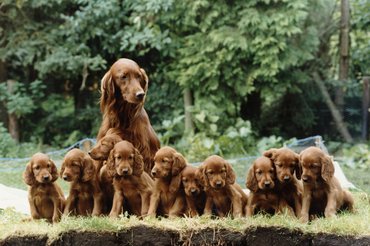
Bathing is needed only rarely. Their ears and eyes must also regularly have time devoted to their care. If their claws grow too long, they must be cut. Since they can be prone to gastric torsion, it is worth feeding them twice a day, rather than once with a larger portion.
The dysplasia characteristic of larger dogs can also occur in the Irish Setter. In addition they can be prone to epilepsy, as well as joint problems, eye diseases, and possibly gastric torsion.
(Source: Szinák János – Veress István: A világ kutyái I., David Alderton: Kutyák, Dr. Sárkány Pál: Nemzetközi Kutya-enciklopédia, Paul McGreevy: Kutyák, Sarah Whitehead – Beverly Cuddy: Kutyák, Dr. Király Klára: Versek, legendák és bölcsességek Kutyabarátoknak, Szinák János – Veress István: Kutyakalauz)
Follow us!
facebook instagram youtube spotify
Related articles